Research (Planning, Conducting, and Reporting) Quiz # 7

Instructions
Quiz: Research (Planning, Conducting, and Reporting) Quiz # 7
Subject: Measures And Survey Research Tools
Total Questions: 30 MCQs
Time: 30 Minutes

Note

  • Do not refresh the page while taking the test.
  • Results along with correct answers will be shown at the end of the test.
Research (Planning, Conducting, And Reporting) Quiz # 7
Question 1 of 30
00:00
  • Make assumptions about the population fitting a normal distribution is called Parametric Statistics

  • Nonparametric statistics make no assumptions about the population fitting a particular normal distribution is called Nonparametric Statistics

  • Data on an interval scale; often contrasted with categorical data is called

  • Likert Scale is frequently used scale type where the anchors are typically ___ degrees of agreement-disagreement to statements

  • Specific points on a rating scale (each one is a separate anchor) is called anchors

  • Ability of the scale to detect differences is called scale sensitivity

  • Quantifiable aspects of your measure that indicate its statistical qualities is called psychometric properties

  • American Psychological Association (APA) database of test records that typically provides the test items is called Psyctests®

  • Database of instruments that indicates the sources in which a particular instrument is used is called Health and Psychosocial Instruments

  • Part of the information in PsycTESTS® that may give you psychometric information about a scale is called detailed record

  • Items in a survey stated in a manner that is opposite that of the other items and whose anchors need to be _____ is called reverse scoring

  • Test–Retest Reliability is a form of reliability in which the instrument is given at two points in time and the scores are correlated

  • Is a form of reliability in which equivalent forms of a test are shown to be reliable

  • One form of reliability of a measure in which the instrument is split into halves and the halves are correlated with each other; sometimes referred to as Spearman-Brown is known as Split-Half Reliability

  • Validity of a measure that focuses on its representativeness from the domain of interest (e.g., a spelling test for fifth graders composed of words selected from books read by fifth graders) is known as

  • Type of validity in which the measures subjectively appear to assess what you claim is called

  • Degree to which test scores predict the behavior of interest; _____ types is called Criterion-Related Validity

  • Demonstration of agreement between measures hypothesized to be theoretically related; contrasted with divergent validity

  • Demonstration of agreement between measures hypothesized to be theoretically related; contrasted with divergent validity

  • Situation in which measures hypothesized to be theoretically unrelated are, in fact, unrelated

  • Validity in which a measure is shown to forecast (predict) the outcome of interest (the criterion) is known as

  • One of two types of criterion oriented validity; when the test (the predictor) and the outcome (the criterion) are assessed at the same point in time

  • Restriction of Range is when the distribution of scores is not widely dispersed across the range of interest; affects the size of your correlation

  • Degree to which a measure assesses what it is hypothesized to measure; usually documented through a series of studies reflecting a nomological network or series of lawful relationships (Cronbach & Meehl, 1955) is called

  • Linked to the work of Cronbach and Meehl (1955) concerning the kinds of lawful relationships you would discover to validate a construct is called Nomological Network

  • Provides _____ for the ease of reading of a given passage; available through word processing programs is called Flesch–Kincaid Scale

  • _____ that can affect the relationship between the dependent variable and the independent variables being assessed is called covariate

  • Using reaction time, this approach measures respondents’ associations between concepts and is considered a way to reduce the social desirability of responses is called

  • Research to assess implicit ______ is called project implicit

  • In a survey, the statement, question, or prompt to which the respondent replies is called stem

Research (Planning, Conducting, And Reporting) Skill Assessment

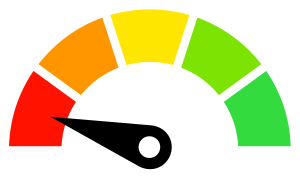
Overall Skill Level-Poor

Your Skill Level: Poor

Retake Quizzes to improve it

Research (Planning, Conducting, And Reporting) Skill Assessment

Overall Skill Level-Poor

Your Skill Level: Poor

Retake Quizzes to improve it