Research Methods (Social Work) Quiz # 3

Instructions
Quiz: Research Methods (Social Work) Quiz # 3
Subject: Quasi Experimental Designs
Total Questions: 30 MCQs
Time: 30 Minutes

Note

  • Do not refresh the page while taking the test.
  • Results along with correct answers will be shown at the end of the test.
Research Methods (Social Work) Quiz # 3
Question 1 of 30
00:00
  • _____ refers to the selection of persons to include in the comparison group who are similar in demographics to those who are in the experimental group.

  • Quasi-experimental designs that evaluate the ______ of a particular intervention can be used to inform social work practice.

  • Results from quasi-experimental design studies can lay the groundwork for developing a/an ______.

  • Quasi-experimental design cannot be used to establish ______.

  • Changes in the target behaviors are due to the client recording his or her behavior is known as ______.

  • When an individual in the intervention group shares information about the intervention with an individual in the comparison group, this is known as ______.

  • When participants in a comparison group become aware of the intervention and feel they are being denied the benefits of such intervention, and therefore do less well on the dependent variable than they would have outside of the experiment, this is called ______.

  • Quasi-experimental designs are used when it is not ethical to assign participants to an experimental or control group.

  • A quasi-experimental design is one where the researcher manipulates the independent variable without the random assignment of participants to an experimental group.

  • In this design, the group not receiving the intervention is referred to as the “control group.”

  • The focus of qualitative research is to discover the meaning ______ give to their interactions with others.

  • In qualitative research, the ______ is the instrument for data collection and analysis.

  • Qualitative researchers must be mindful of their personal ______.

  • Reflecting on a researcher’s assumptions and values is known as researcher’s ______.

  • ______ is the researcher’s understanding of the phenomenon.

  • What is a researcher called when they study a group they belong to?

  • ______ is also referred to as empathic neutrality.

  • Which sampling strategy involves selecting persons from the target population based on a certain attributes that the researcher has established?

  • As an observer, the researcher has no or minimal interactions with the participant.

  • Full participant refers to being both a member of the setting in which the research is being conducted and not being the person conducting research.

  • Which of the following statements is TRUE about a sequential transformative mixed-method study?

  • What is the primary difference between identical and parallel sampling?

  • A ______ design is when both qualitative and quantitative methods are used simultaneously.

  • ______ is a type of mixed-method design where a researcher first collects and analyzes quantitative data and then collects and analyzes qualitative data.

  • What type of design is it if the researcher introduces the qualitative or quantitative method first depending upon the research purpose?

  • ______ is a type of mixed-method design where a researcher first collects and analyzes qualitative data and then collects and analyzes quantitative data.

  • In mixed-methods research, issues related to internal validity or trustworthiness are referred to as ______ quality.

  • ______ sampling produces a sample where different individuals are included in both the qualitative and quantitative samples, but these individuals have been chosen from the same population.

  • Mixed-methods research seeks to answer research questions in a single study at a time.

  • Multilevel sampling involves selecting a subset of individuals who participated in the quantitative data collection, and including them in the qualitative sample.

Research Methods (Social Work) Skill Assessment

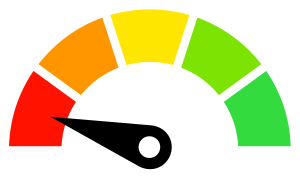
Overall Skill Level-Poor

Your Skill Level: Poor

Retake Quizzes to improve it

Research Methods (Social Work) Skill Assessment

Overall Skill Level-Poor

Your Skill Level: Poor

Retake Quizzes to improve it